Wondering if every waterfront home in Cape Coral is automatically a boater’s dream? Not quite. If you want to keep your boat at home and enjoy smooth days on the water, the details behind the lot matter just as much as the view. This guide will help you sort through freshwater versus saltwater access, bridge and route concerns, dock and lift planning, and practical alternatives if you do not want a private dock. Let’s dive in.
Why Cape Coral Appeals to Boat Buyers
Cape Coral is built around water. The city says its canal system spans more than 400 miles, with many canals offering direct access to the Caloosahatchee River and the Gulf.
That kind of waterfront network creates real opportunity for buyers who want a boating lifestyle. At the same time, it also means you need to look beyond the words waterfront home and ask how that property actually works for your boat and your routine.
The city also notes that its canal system serves several functions, including flood control, water quality, and irrigation. In other words, canals are not all the same, and a home on the water is not automatically set up for the kind of boating you have in mind.
Know the Canal Type First
If you only ask one boating question before buying in Cape Coral, make it this: Is the property on a freshwater canal or a saltwater route? That answer shapes how you will use the home and what kind of boating experience you can expect.
Freshwater canals in Cape Coral
Cape Coral’s canal map separates freshwater and saltwater systems, and the city describes about 300 linear miles of freshwater canals that collect stormwater. The city’s route information also shows freshwater launch areas connected to inland canals and lakes.
For many buyers, a freshwater lot may work well if you enjoy inland cruising, kayaking, or keeping boating local. It can also be a practical fit if you plan to trailer your boat rather than rely on a direct route toward open water.
Saltwater and river-connected canals
The city’s route descriptions show that some launch points connect to the Caloosahatchee River and then toward the Gulf, while others lead toward Matlacha Pass. That makes saltwater or river-connected locations especially important for buyers who want more routine access beyond the canal system itself.
If your goal is to leave from your backyard and head toward open water more often, the route matters far more than the mailing address. Two homes may both be called waterfront, but their boating convenience can be very different.
Route to Open Water Matters
A Cape Coral boating home should be judged by the full trip, not just the dock. You want to know how your route works from the lot all the way to the river, pass, or Gulf access point you plan to use most.
The city provides useful benchmarks through its public saltwater launch facilities. Rosen Park offers access to the Gulf via the Caloosahatchee River and is about 11.2 statute miles from the Sanibel Causeway Bridge, while Horton Park offers similar river-to-Gulf access and is about 10.9 statute miles from that bridge.
Those numbers help you picture real-world travel better than broad marketing language. If a property seems ideal on paper, it is still worth asking how long the route feels in practice and whether it matches how often you expect to head out.
Launch areas that show route differences
The city’s boating and route descriptions give a helpful snapshot of how different Cape Coral access points function:
- BMX launches into Shelburne Canal and nearby freshwater lakes
- Burnt Store launches into Rosemary Canal and leads to Matlacha Pass
- Rosen Park connects through Chantry Canal to the Caloosahatchee River
- Horton Park connects through Everest Canal to the Caloosahatchee River
These route examples make one thing clear: boating convenience in Cape Coral is highly location-specific.
Check Bridges Before You Buy
Bridge clearance is not a small detail in Cape Coral. The city says there are 161 bridges within the city, so you should assume route restrictions may be part of the decision.
Match the route to your boat
When you evaluate a property, think about your boat’s length, height, and beam together. A lot may look perfect for docking, but the route out may not be ideal if bridges or narrow canal geometry create limits.
This is why experienced waterfront buyers focus on the entire boating path, not just canal frontage. The most useful question is not simply, Can I dock here? It is, Can I comfortably get from here to where I want to go?
Neighborhood name is not enough
In Cape Coral, a familiar neighborhood name does not tell you everything about boating usability. Two homes in the same general area may have very different routes, canal widths, turns, and bridge considerations.
That is especially important if you own a larger vessel or plan to change boats later. A home that works for your current setup may feel limiting if you upgrade in the future.
Look Closely at Dock and Lot Geometry
A waterfront lot’s practical boating value includes more than water frontage. Cape Coral’s marine-improvement application asks for details such as canal type, dock projection into the canal, side projections, and whether the parcel is on the river or the Spreader Canal.
That tells you something important as a buyer: dock geometry and canal alignment are part of the property’s usefulness from day one. They are not just construction details to sort out later.
Questions to ask about the lot
Before you move forward on a waterfront purchase, consider asking:
- What type of canal is this property on?
- Does the current dock setup fit your boat?
- Is there space for the dock or lift layout you want?
- How does the canal alignment affect turning and maneuvering?
- Are there route or bridge issues between the lot and open water?
These questions can help you compare properties more clearly, especially when several homes appear similar online.
Can You Add a Dock or Lift Later?
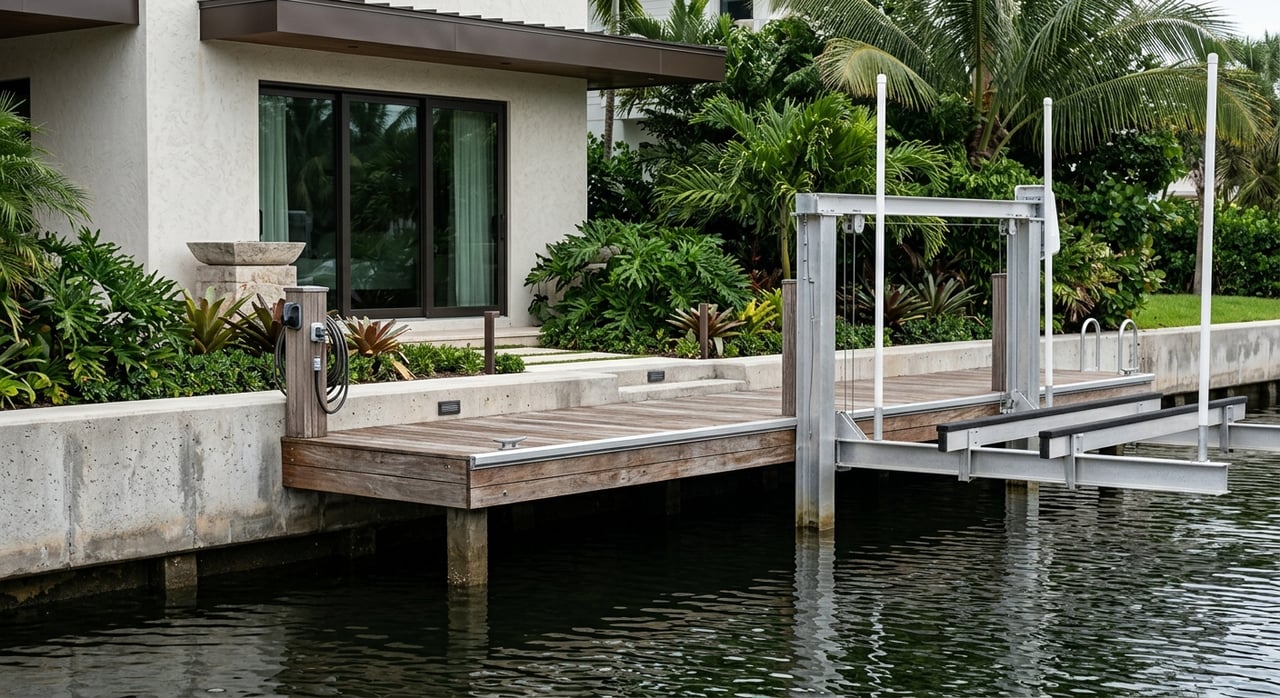
In many cases, yes, but you should expect a permit-driven process. Cape Coral’s marine-improvement requirements for a new wood dock include a site plan, dock layout, dock details, lift engineering if a lift is being installed, and DEP approval if the property is not on fresh water.
The city also states that a dock can be built with or without a lift. If you plan to install lift wiring, a separate electrical permit is required, and a used lift may require a hold-harmless agreement.
Seawalls matter too
If a property needs seawall work, that also comes with formal requirements. The city’s residential seawall guideline notes that DEP approval is required if the property is not on fresh water, and a concrete dock can be included in the seawall permit.
Before final inspection on docks, wharves, mooring piles, and watercraft moorings, the city requires a final signed and sealed survey showing compliance with the Land Development Code. For buyers, that means future improvements can be very doable, but they should not be treated as casual weekend projects.
You Do Not Need a Private Dock to Enjoy Boating
Not every boat-loving buyer wants the maintenance or expense of a private dock. In Cape Coral, that does not mean boating has to be off the table.
The city says its improved ramps are open 24 hours a day, 7 days a week unless closed for safety or repairs. Trailer parking at improved ramps costs $15 per day or can be covered by an annual resident or business decal.
A smart option for flexible buyers
If you love boating but do not need a boat behind the house, a non-dock property plus public launch access may still fit your lifestyle well. This can open up more home options while keeping boating part of your routine.
That approach may also make sense if you are buying a second home and want a simpler ownership experience. Instead of paying a premium for direct dockage, you may decide convenience means quick launch access and less waterfront upkeep.
A Simple Home Search Strategy for Boat Buyers
When you search for a boating property in Cape Coral, it helps to narrow your priorities in the right order. The prettiest water view is not always the best boating match.
Start with these priorities
Define your boating style Decide whether you want inland cruising, river access, or more regular trips toward the Gulf.
Confirm canal type Separate freshwater homes from saltwater or river-connected options early in your search.
Review the route Look at the full path from the property to your likely destination, not just the lot itself.
Account for bridges Compare your boat’s dimensions to the route and keep future boat plans in mind.
Evaluate dock potential If the current setup is not ideal, check whether the lot may support the dock or lift plan you want.
Consider launch alternatives If direct dockage is not essential, public ramp access may widen your choices.
Why Guidance Matters in a Waterfront Search
Cape Coral offers real boating variety, but that also means the details can get technical quickly. Freshwater versus saltwater, route distance, bridge clearance, dock layout, and permit requirements all affect how well a property supports your lifestyle.
That is why a thoughtful home search matters so much in this market. If boating is part of how you want to live in Southwest Florida, the goal is not just to buy a waterfront home. It is to buy the right waterfront home for the way you actually use the water.
If you are exploring Cape Coral or other Southwest Florida waterfront options, Sara Anderson, PA offers personalized guidance to help you compare properties with clarity and confidence.
FAQs
What does waterfront mean for boat buyers in Cape Coral?
- In Cape Coral, waterfront does not always mean easy boating access to open water. The city’s canal system includes both freshwater and saltwater routes, so you need to confirm how the specific property connects.
What is the difference between freshwater and saltwater canals in Cape Coral?
- Freshwater canals are generally better suited to inland cruising and local water use, while saltwater or river-connected routes are typically more relevant for buyers who want regular trips toward the Caloosahatchee River, Matlacha Pass, or the Gulf.
Why should boat owners check bridges when buying in Cape Coral?
- Cape Coral has 161 bridges, according to the city, so bridge clearance can affect whether your boat can comfortably travel from the property to your intended destination.
Can you add a dock or boat lift after buying a home in Cape Coral?
- Yes, but Cape Coral’s marine-improvement process requires permits and may involve site plans, dock layouts, lift engineering, electrical permits, DEP approval for some properties, and final survey requirements.
What if you want boating access in Cape Coral without a private dock?
- Cape Coral’s improved public ramps are open 24/7 unless closed for safety or repairs, and trailer parking is available for a daily fee or through an annual resident or business decal.
How can you judge boating convenience from a Cape Coral lot?
- A good starting point is to look at canal type, the route to the river or pass, bridge considerations, and whether the dock layout and canal geometry fit your boat and boating plans.